OSHA 29 CFR 1926 · Construction
Point a camera at the site.Get the citation back.
SiteSafety Copilot reads a jobsite photo and a foreman's voice note, boxes every violation, cites the exact OSHA paragraph, and says what to fix, out loud, before the crew starts work.
- < 45s
- spoken briefing
- 0–1000
- box contract
- 6
- OSHA subparts
Risk score
0—
- Reading frame…
Grounded only in
Subpart MFall protection
Subpart LScaffolds
Subpart PExcavations
Subpart XLadders
Subpart EPPE
Subpart KElectrical
How it works
From a photo to a signed-off morning briefing.
- 01
Capture
Take a photo from the deck, or pull a frame from a walkthrough. Hold the mic and say what you see: “leading edge looks open on three.” The voice note rides along as context.
image + audio_transcript
- 02
Analyze
Every violation gets a box on a 0 to 1000 grid, an exact 29 CFR 1926 paragraph, a severity, and a physical fix. Points add up to a single site risk score.
box_2d · osha_citation · severity_weight
- 03
Brief the crew
The assistant reads each finding aloud in three sentences or fewer. Then export the daily JHA and a toolbox-talk presentation that runs under 45 seconds.
audio_response_script · JHA · .mp4
Try it
Click a box. Read the rule.
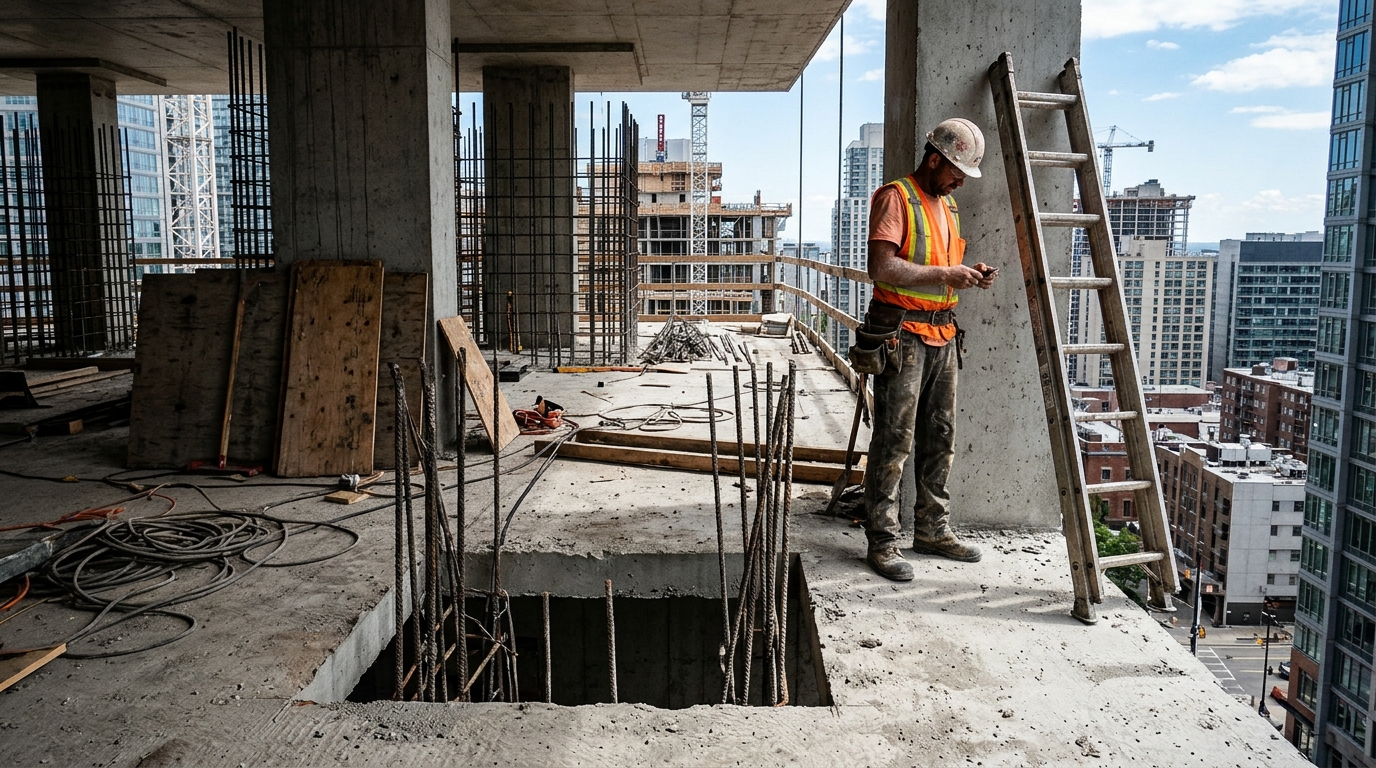
Three real-looking scenes, annotated the way the engine annotates them. Select a violation to see the citation, the fix, and the points it adds to the score.
1. Unprotected perimeter edge
+35 ptsCRITICAL29 CFR 1926.501(b)(1)
OpenAction:Confidence: 95%[145, 600, 760, 730]2. Uncovered slab penetration with rebar
+32 ptsCRITICAL29 CFR 1926.501(b)(4)
OpenAction:Confidence: 92%[455, 247, 930, 603]3. Ladder rails not extended 3 ft
+22 ptsHIGH29 CFR 1926.1053(b)(1)
OpenAction:Confidence: 89%[65, 715, 815, 860]
What it does
Built for the person walking the deck, not the person reading the report.
The Phase 1 demo runs on a deterministic mock engine. Live Bedrock vision, Polly voices and FFmpeg export are the Phase 2 build.
- Boxes that stay put
- Coordinates are normalized integers, never pixels, so a box lands on the same hazard on a phone, a tablet, or a trailer monitor.
- Voice in, voice out
- Dictate observations with push-to-talk. Hear each finding back, or run an audio tour that highlights the matching box as it speaks.
- A score that moves with the work
- Mark a hazard Stop Work or Corrected and the site score drops in real time, with the points mitigated shown.
- Audit-ready JHA
- A daily Job Hazard Analysis with a PPE check, hazard matrix, status per item, and signature blocks for the superintendent and crew lead.
- Toolbox talk in 45 seconds
- Greeting, primary concern, physical fix, sign-off. The narration is written for the ear and capped so the crew actually listens.
- No invented citations
- The model is held to the paragraphs in the OSHA 1926 corpus. If it is not sure, it drops the finding rather than guess a number.
The rulebook
Cited to the paragraph.
| Citation | Requirement | Typical severity |
|---|---|---|
| 29 CFR 1926.501(b)(1) | Unprotected sides and edges 6 ft or higher need fall protection. | CRITICAL |
| 29 CFR 1926.652(a)(1) | Trenches 5 ft or deeper need a protective system. | CRITICAL |
| 29 CFR 1926.451(g)(4) | Scaffold top rails 38–45 in, mid-rails halfway down. | HIGH |
| 29 CFR 1926.1053(b)(1) | Ladders extend 3 ft above the upper landing. | HIGH |
| 29 CFR 1926.100(a) | Hard hats where head injury is possible. | MEDIUM |
Walk the site before the crew does.
Load a preset scene or upload your own photo. No account needed.